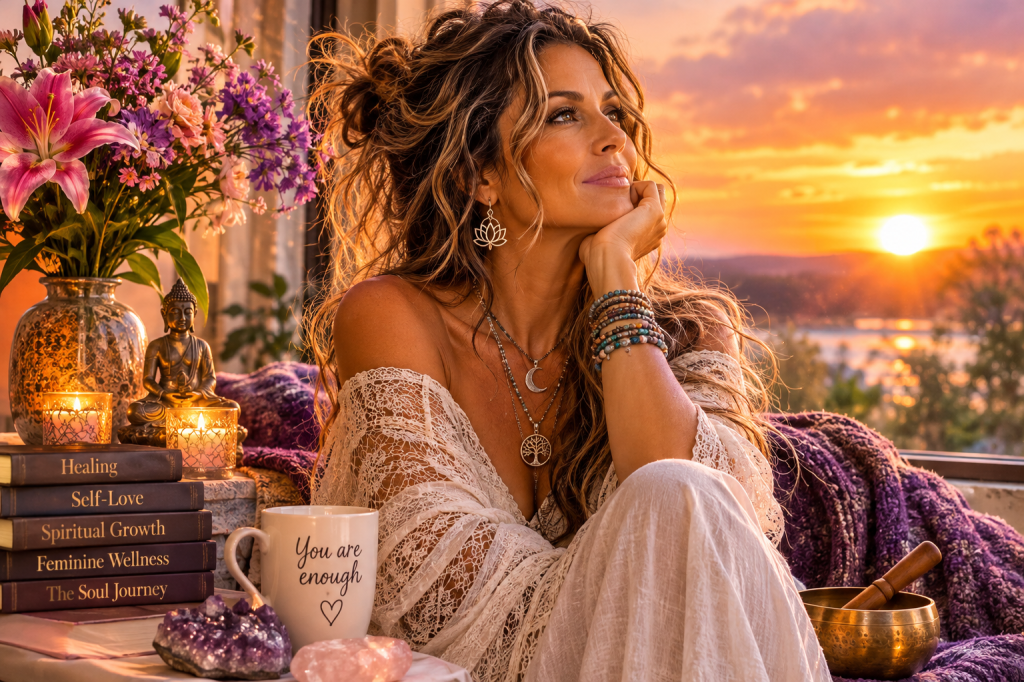
A conversation about emotional availability, motherhood, loneliness, feminine energy, and learning to receive the love we so freely give.
There is a particular kind of woman I want to talk about today.
She may be a mother. She may be a single mother. She may have been married, divorced, separated, or spent years trying to build a relationship with someone she genuinely believed would be her person.
She is a woman who has lived, learned, worked, loved, lost, rebuilt, and continued moving forward.
She has raised children, managed households, built careers, started businesses, supported others, and found ways to keep going even when life didn’t necessarily give her the support she needed.
She may be an entrepreneur, a teacher, a healer, an artist, an activist, a caregiver, a homemaker, or a woman who has learned to wear many different hats.
She can balance a budget, manage her responsibilities, take care of her family, nurture her friendships, maintain her independence, and create a beautiful life.
She can be sensual, playful, passionate, intelligent, nurturing, adventurous, spiritual, and deeply loving.
She has worked on herself. She communicates. She reflects. She tries to understand other people’s perspectives. She makes an effort to create time for connection and believes that healthy relationships require intention, honesty, and participation from both people.
And yet, sometimes she finds herself in the same familiar place.
She meets someone who seems genuinely interested. He pursues her. He tells her how incredible she is. He recognizes everything she brings into a relationship. He may even tell her that she is everything he could ever want in a woman.
He sees the mother, the professional, the independent woman, the passionate lover, the nurturer, the free spirit, and the woman who can stand on her own two feet.
He tells her how different she is.
How much he admires her.
How much he wants her.
But when it comes time to build something consistent, intentional, and meaningful, suddenly there is uncertainty.
He doesn’t know what he wants.
Things feel too intense.
He needs time.
He isn’t ready.
He wants her, but he isn’t sure about commitment.
And there she is again, trying to understand how someone can recognize so much beauty in her but still struggle to show up in a way that makes her feel secure.
When being independent becomes a way of life
Many women learn independence very early.
Some become mothers young. Others find themselves carrying the responsibilities of a household, a marriage, or a family while simultaneously trying to discover who they are as individuals.
Some have experienced relationships where they had to become the provider, problem solver, emotional support system, and the person who kept everything functioning.
Over time, independence becomes more than a strength. It becomes a survival skill.
She learns not to ask for too much. She figures things out. She creates solutions. She stops waiting for someone to come through because she has learned that she can depend on herself.
And while there is something incredibly powerful about a woman knowing she can take care of herself, we should also acknowledge the other side.
Sometimes the woman who can do everything is exhausted from always having to do everything.
Sometimes she doesn’t want to make another decision.
Sometimes she wants someone else to plan the evening, make dinner, initiate the conversation, remember the little things, and show her through their actions that she doesn’t have to carry the entire relationship.
She doesn’t want to lose her independence.
She wants to experience partnership.
There is a difference.
The emotional exhaustion of almost relationships
One of the more difficult relationship experiences is not necessarily being rejected.
Sometimes it is being continuously pursued by someone who seems to want everything about you, yet cannot decide whether they are willing to participate in building a relationship.
It can become a cycle.
There is connection, affection, attraction, conversation, intimacy, and the possibility of something meaningful.
Then comes uncertainty.
You begin asking questions because you want clarity. You try to communicate your needs. You suggest spending time together. You express that consistency matters to you.
You aren’t necessarily asking for marriage tomorrow or a lifetime promise after three dates.
You’re asking whether two adults can intentionally explore a relationship without playing emotional guessing games.
But somehow, expressing a desire for consistency becomes interpreted as pressure.
And this can leave a woman questioning herself.
Am I asking for too much?
Am I moving too quickly?
Am I being too intense?
Should I be more patient?
Should I give him more space?
Should I stop expressing what I need?
This is where we need to pause.
Having emotional needs does not automatically make you demanding. Wanting communication does not make you controlling. Wanting to know where you stand does not mean you are trying to take away someone’s freedom.
Two people can have different relationship timelines. That is perfectly valid.
But emotional availability requires honesty. If someone doesn’t know what they want, they have a responsibility to communicate that rather than keeping another person emotionally invested in a possibility they may never intend to pursue.
And a woman has a responsibility to herself to decide whether that uncertainty is something she is willing to live with.
The loneliness that doesn’t always look like loneliness
This is something I believe deserves more conversation.
You can have a beautiful life and still experience loneliness.
You can wake up grateful, enjoy your morning coffee, go to work, take care of your children, exercise, spend time with friends, work on your business, and genuinely enjoy your own company.
You can laugh, dance, travel, explore new interests, and feel proud of the woman you have become.
And then, sometimes, it happens.
You’re sitting on the couch watching a movie.
You make a beautiful dinner.
You see something funny and instinctively want to turn to someone and share it.
You have a wonderful day and wish there were someone who genuinely wanted to hear all about it.
You have a difficult day and wish you could rest your head on someone’s shoulder without wondering what it might cost you emotionally later.
And a little sadness comes over you.
Not because your life is empty.
But because there are experiences you would love to share with someone.
There is a difference between being alone and feeling unseen.
There is a difference between enjoying solitude and longing for companionship.
We should never make women feel that wanting romantic love means they haven’t learned to love themselves.
Self-love and the desire for partnership can exist at the same time.
You can be whole as an individual and still want someone to build something beautiful alongside you.
What happens to the body when the heart is tired?
Our emotional experiences don’t exist separately from our physical bodies.
Prolonged emotional stress, relationship uncertainty, repeated disappointment, and the pressure of carrying responsibilities can affect how we feel physically and emotionally.
Some women notice difficulty sleeping, muscle tension, headaches, changes in appetite, fatigue, irritability, or difficulty relaxing.
Others find themselves constantly thinking about conversations, replaying interactions, trying to understand what happened, or anticipating the next emotional shift.
When a relationship feels unpredictable, it can be difficult to settle into a sense of emotional security.
The body may remain tense even when the relationship is temporarily peaceful.
This is why healing needs to involve more than simply telling ourselves to move on.
We need opportunities to slow down, reconnect with our bodies, recognize our emotions, and create practices that support our overall well-being.
We need to learn how to distinguish genuine connection from emotional uncertainty.
And sometimes, we need a safe place where we don’t have to be the strong one.
The spiritual side: Are we repeating a pattern?
From a spiritual perspective, many women begin to wonder whether their relationship experiences are connected to karma, past wounds, generational patterns, or something they are meant to learn.
They may ask:
Why do I keep meeting emotionally unavailable people?
Why do I attract people who want me but cannot commit?
Why do I keep giving so much?
Why do I feel responsible for helping someone become the person I need them to be?
Is there something I need to release?
I don’t believe that difficult relationships are proof that a woman is cursed, undeserving, or being punished by the universe.
But I do believe there is value in exploring recurring patterns.
Sometimes our earliest experiences shape what feels familiar in adulthood. We may become accustomed to being the caretaker, the peacemaker, the patient one, or the person who works harder to maintain connection.
We may confuse intensity with intimacy, attention with commitment, or being needed with being loved.
From a soul-growth perspective, this can become an invitation to examine what we have accepted as love.
Not to blame ourselves.
Not to shame our past decisions.
But to become more conscious of the relationships we choose to participate in moving forward.
Perhaps the lesson isn’t to become stronger.
Perhaps the lesson is to stop believing that love must be difficult to be meaningful.
Perhaps it is time to learn how to receive.
Healing the woman beneath all the responsibilities
At Soul Journey Guidance, I believe healing should be approached through the whole person.
We are not just minds trying to understand our experiences. We are emotional, physical, spiritual, and creative beings.
Sometimes talking helps. Sometimes movement helps. Sometimes silence, touch, breath, creativity, or simply having someone hold space for us can help us reconnect with ourselves.
Here are some of the ways we can begin exploring that journey together.
Meditation and breathwork
Learning to slow down the mind, recognize emotional patterns, and create moments of stillness. Meditation can help us become more aware of our thoughts without allowing every thought to dictate how we feel or respond.
Womb-centered care and feminine wellness
Creating intentional space to reconnect with the body, explore feminine identity, and honor the physical and emotional experiences associated with womanhood. This can include gentle movement, relaxation, reflection, and nurturing self-care.
Soul mentoring and personal guidance
Exploring relationship patterns, boundaries, self-worth, emotional needs, personal values, and the difference between what we desire and what we continue accepting.
Massage therapy and intentional bodywork
Giving the body an opportunity to relax, release everyday muscular tension, and experience nurturing care. Sometimes we spend so much time touching the lives of others that we forget the importance of receiving care ourselves.
Yoga and mindful movement
Reconnecting breath, body, and mind through movement. Yoga can offer a space to practice being present, listening to the body, and finding comfort in our own physical experience.
Art, creativity, and dance
Not every emotion needs to be explained through words. Sometimes we need to paint, write, create, move, dance, or simply allow ourselves to play again.
Creativity can provide another way to explore emotions and reconnect with parts of ourselves that have been quiet beneath years of responsibilities.
These practices are not about fixing a broken woman. They are opportunities to nurture well-being, develop self-awareness, and support a more compassionate relationship with ourselves. When deeper emotional wounds need clinical care, working with a licensed mental health professional can also be an important part of the journey.
Learning to recognize the love you deserve
Healing also means changing the way we evaluate relationships.
Instead of asking how much someone wants us, we begin asking whether their actions demonstrate that they are capable of participating in a healthy relationship.
Instead of measuring connection by how often someone says they miss us, we pay attention to whether they make time to see us.
Instead of being impressed by promises, we look for consistency.
Instead of trying to convince someone to choose us, we allow their choices to provide information.
We begin understanding that:
- Attraction is not the same as emotional availability.
- Chemistry is not the same as compatibility.
- Attention is not the same as commitment.
- Apologies are not the same as changed behavior.
- Being someone’s ideal woman is not the same as being treated with love and respect.
And perhaps most importantly, we stop treating our needs as something we should apologize for.
A healthy relationship should allow room for two individuals to have their own lives while intentionally creating a shared one.
It should have room for independence and togetherness, affection and honesty, intimacy and friendship, freedom and responsibility.
You shouldn’t have to make yourself smaller to keep someone comfortable.
And you shouldn’t have to become someone’s entire world to feel important in their life.
You are allowed to want more
If you recognize yourself somewhere in this conversation, I want you to know that you aren’t alone.
You may be a woman who has spent years raising children, building a career, supporting others, and creating a life you are proud of.
You may be coming out of a marriage.
You may be navigating dating again after years away from it.
You may be in a relationship that leaves you questioning whether your emotional needs are being heard.
Or perhaps you have finally found peace in your own company, but every once in a while, you still wish there were someone to share that peace with.
There is nothing shameful about that.
You don’t need to stop wanting love.
You don’t need to stop being passionate.
You don’t need to become detached, cold, or unavailable to protect yourself.
You can remain loving while developing boundaries.
You can remain feminine while being independent.
You can be sexually confident while requiring emotional safety.
You can be a mother, entrepreneur, teacher, healer, creator, and a woman who simply wants to be held.
You are allowed to have all those parts of yourself.
And you are allowed to build a life where love is something you receive, not just something you constantly give.
A little invitation from Soul Journey Guidance
I created Soul Journey Guidance as a space for intentional self-discovery, holistic wellness, personal growth, and reconnection.
My approach is rooted in the understanding that every woman’s journey is different. There is no single path to healing, and there is no timeline that determines when you should feel ready to begin again.
Sometimes we need conversation.
Sometimes we need stillness.
Sometimes we need movement, bodywork, creative expression, or a little time away from the responsibilities of everyday life.
And sometimes we simply need a safe, welcoming space where we can show up exactly as we are.
Through personal soul mentoring, meditation, yoga, massage therapy, holistic wellness practices, and creative experiences, we can explore what it means to reconnect with yourself and move forward with greater awareness and intention.
You do not have to have all the answers before you begin.
You just have to be willing to give yourself the same care, patience, and attention that you have spent so many years giving everyone else.
You have spent a lifetime learning how to show up for others. Perhaps this is the season to learn how to show up for yourself.
With love and intention,
Soul Journey Guidance
Sacred Guide • Soul Mentor • Holistic Wellness Practitioner
Your journey matters. Let’s make space for it.
Explore Soul Journey Guidance and book a personal healing session


Leave a Reply