Why the words matter—and why respect matters more.
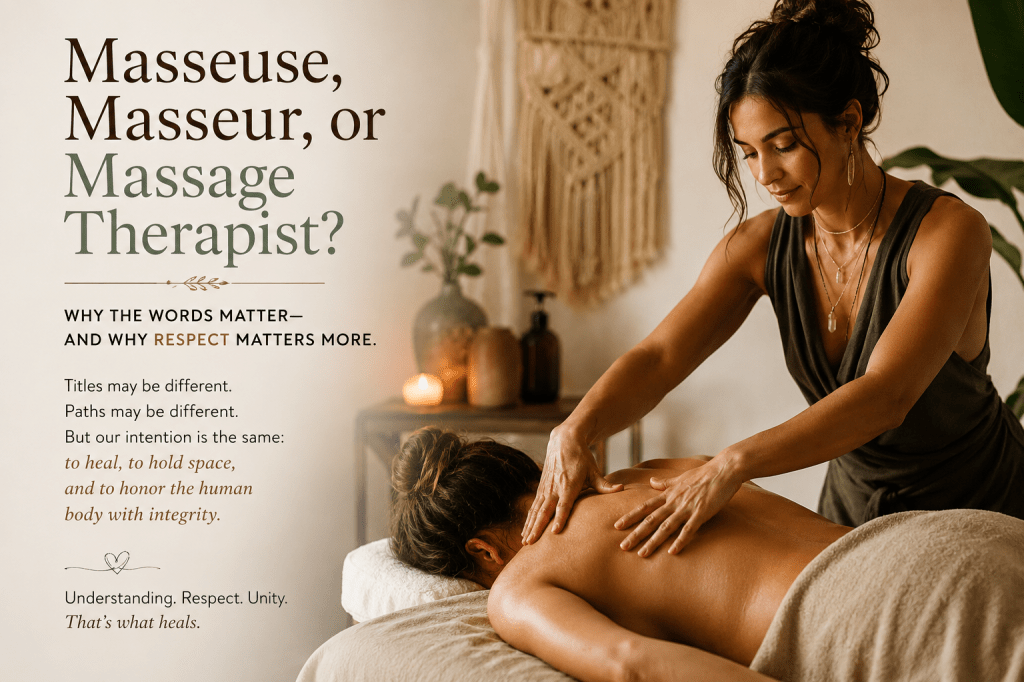
There’s a conversation in the bodywork world that keeps coming up, and honestly, it often carries a lot more heat than understanding.
The words masseuse and massage therapist.
For some, being called a “masseuse” feels offensive. For others, it’s simply the word they grew up hearing and using. And for many outside the industry, there’s no harmful intent behind it at all.
So where did this divide come from?
The history of the word “masseuse”
The word masseuse originated in France in the late 1800s. It is the feminine form of masseur, meaning a person who practices massage. The word itself was never sexual in origin—it simply described someone skilled in bodywork.
The word massage itself traces back to French, likely influenced by Arabic massa (“to touch, feel, handle”) and possibly Portuguese amassar (“to knead”). Historically, massage was a respected healing art across cultures long before modern licensure existed.
In Europe, especially France and parts of other European countries, the words masseuse and masseur have remained common and often neutral. They do not automatically carry the same stigma they do in the United States.
So what changed in America?
In the United States, during the late 1800s and into the 1900s, the term “massage parlor” became heavily associated with prostitution. This cultural shift created a stigma around the words masseuse and masseur, even though those terms originally meant legitimate practitioners.
By the 1980s, as formal massage schools expanded and state licensure became more common, the term massage therapist became the preferred title in the U.S. It created distance from that stigma and aligned the profession with healthcare, rehabilitation, and wellness.
This shift was important.
But here’s where we need nuance.
A title does not define integrity
Yes, licensed massage therapists have education, training, and legal accountability. That matters.
And yes, passing licensure exams means you have studied anatomy, physiology, pathology, ethics, and safe practice.
That matters too.
But licensure does not make someone superior as a human being.
And it does not give anyone permission to shame others.
Not every skilled bodyworker is licensed.
Not every healer went through a formal massage program.
Not every person using the word masseuse is promoting sex work.
And not every unlicensed practitioner is unsafe.
There are traditional healers, somatic practitioners, intuitive bodyworkers, energy workers, trauma-informed touch practitioners, and cultural lineage-based bodyworkers who hold incredible skill, wisdom, and healing presence.
Healing has existed far longer than state boards.
Holding space is a skill too
This is where the conversation often gets bigger than technique.
Because bodywork is not only about muscles.
It’s about nervous systems.
Trauma.
Stored emotion.
Grief.
Safety.
Trust.
Presence.
You can know every origin and insertion point in the body and still not know how to hold emotional space for someone releasing years of pain.
And on the other hand, someone may have deep intuitive touch, trauma awareness, and somatic understanding without ever sitting in a massage classroom.
That doesn’t make them less legitimate.
It makes them different.
And different does not equal dangerous.
Not all bodyworkers are sex workers
This needs to be said clearly.
There is a harmful assumption in some professional circles that if someone isn’t licensed, or if they use words like tantric bodywork, sensual healing, or somatic touch, they must be offering sexual services.
That assumption is false.
Sex work exists.
Therapeutic bodywork exists.
Somatic healing exists.
Tantric healing exists.
Energy healing exists.
These are not all the same thing.
Consent, boundaries, intention, and ethics are what define the work—not the title alone.
Education over judgment
If someone calls you a masseuse and you prefer massage therapist, educate them.
But educate—don’t attack.
Most people genuinely do not know the history.
Most clients are not trying to insult you.
Most are using the language they’ve heard their whole lives.
The bodywork world is already fighting enough stigma.
We don’t need to create more division inside our own healing communities.
Respect the licensed therapist.
Respect the somatic healer.
Respect the intuitive bodyworker.
Respect the lineage practitioner.
Respect the person doing honest, ethical healing work.
Because at the end of the day, the body knows truth.
And healing doesn’t always ask for a title before it begins.


Leave a comment