What It Really Means to Heal: Corrective Experiences, Boundaries, and Re-Entering Connection
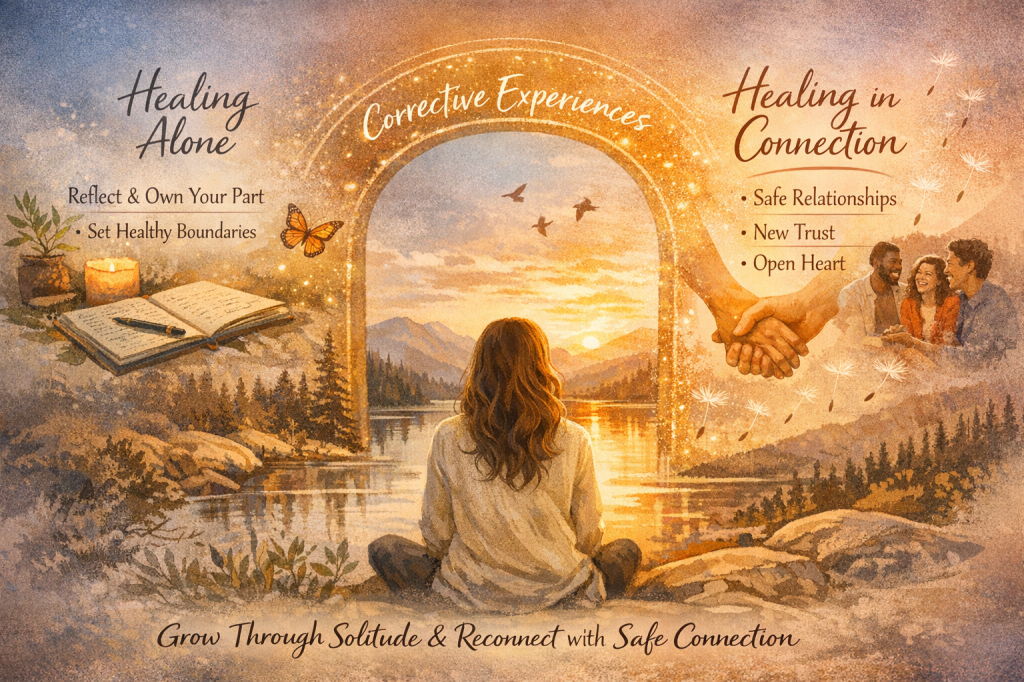
Healing is often talked about as something we do alone—journaling, therapy, rest, self-love, pulling inward to tend to wounds. And while that season of solitude is essential, it is only part of what full healing actually requires.
True healing is not just about surviving what hurt us. It’s about what happens after—how we reflect, take ownership, learn, and eventually allow ourselves to re-enter connection without losing ourselves again.
Healing Begins With Honest Reflection
When a relationship ends—especially a traumatic or abusive one—there is a natural instinct to either blame ourselves entirely or place all responsibility on the other person. Real healing lives in the middle.
Taking time alone allows us to gently ask:
- What parts of this situation were mine to own?
- What patterns did I repeat because they felt familiar?
- What belonged to the other person—and was never mine to fix?
- What did I ignore, excuse, or minimize because I didn’t yet understand red flags?
Ownership is not self-punishment. It is empowerment. When we can clearly see our role and clearly name what was not okay, we reclaim our agency. We get to say:
“I don’t like certain behaviors. I don’t accept certain dynamics. And I am allowed to move forward differently.”
Boundaries Are Not Walls—They Are Wisdom
One of the most important outcomes of healing is learning boundaries.
Boundaries mean:
- You can love someone and still keep them at a distance.
- You can understand someone’s trauma without allowing it to harm you.
- You can say no without explaining yourself into exhaustion.
- You can recognize red flags early—because now you know what they feel like in your body.
This is not becoming cold, closed off, or “too guarded.” This is learning discernment. This is growth.
Boundaries are the evidence that something was learned.
The Missing Piece: Corrective Experiences
What many people don’t realize is that healing cannot happen in isolation forever. The nervous system does not fully heal through insight alone—it heals through new experiences.
This is where corrective experiences (or corrective data) come in.
Corrective data is new, lived evidence that contradicts old beliefs formed through pain.
For example:
- If your body learned that closeness equals danger, a corrective experience is safe closeness.
- If your brain learned that your voice doesn’t matter, a corrective experience is being heard and respected.
- If your nervous system learned to brace for harm, a corrective experience is consistency without punishment.
Corrective data teaches the brain and body that not every connection is unsafe.
The Physical and Nervous System Aspect
Trauma lives in the body, not just the mind. After harmful relationships, the nervous system often stays in a state of hypervigilance—constantly scanning for danger.
Slow, healthy reconnection helps the body learn:
- I can relax here.
- I can leave if I need to.
- I can speak up and survive the response.
- I am safe enough now.
This is why gently returning to dating, friendships, and community—at your own pace—is not a setback. It is part of the medicine.
The Spiritual Aspect of Re-Entering Connection
Spiritually, painful connections often force us inward so we can meet ourselves more deeply. We learn self-trust, intuition, self-respect, and self-love.
But eventually, growth asks us to bring that wisdom back into the world.
Connection becomes a practice:
- Practicing your voice
- Practicing boundaries
- Practicing discernment
- Practicing trust with yourself first
This doesn’t mean forcing closeness. It means allowing proximity without self-abandonment.
You Are Not Broken—You Are Informed
Keeping certain people at a distance is not failure. It is information integrated.
Trying again—slowly, intentionally, with awareness—is not naivety. It is courage.
Healing does not mean you’ll never be hurt again. It means you now know how to protect yourself, advocate for yourself, and leave sooner when something does not feel aligned.
Full Healing Is Both Solitude
and
Connection
There is a time to heal alone.
And there is a time to gather new evidence.
Both matter.
Full healing happens when:
- We reflect honestly
- We take ownership without shame
- We create boundaries without guilt
- We allow safe people close again
- We let our nervous system learn something new
Not everyone is dangerous.
Not every connection will harm you.
And you no longer have to disappear to stay safe.
You get to heal and belong.
Soul Journey Guidance
Christina
 Soul Journey Guidance
Leave a comment